

The core challenges and breakthrough paths of die casting
The die casting process encounters three technical bottlenecks: incomplete filling of thin-walled sections, internal air pocket defects, and dimensional thermal deformation. We have achieved a breakthrough through threefold innovation:
Ultra-high speed pressure system (> 6m/s): Ensures that the molten aluminum liquid fills the 0.3mm fine grid of the lamp housing instantaneously.
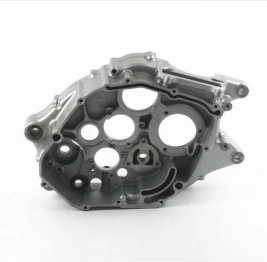
Local pressure and vacuum technology: Eliminates shrinkage cavities at the thick-walled parts of the engine housing bearing seats, increasing the fatigue strength of the gearbox by 30%.
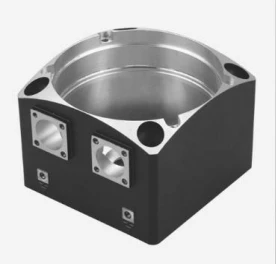
Intelligent temperature control mold: The flatness fluctuation of the electrical housing is controlled within ±0.05mm, meeting the requirements for precise assembly.
Practical cases of significant improvement in product efficiency
For different application scenarios, die-casting technology enhances product performance to an unprecedented level:
In the powertrain field: The integrated die-casting camshaft bracket reduces weight by 40% while maintaining a 2000N impact resistance capability.
Thermal Management Revolution: Integral Casting Heat Sink Achieves Molecular-level Bonding of Copper and Aluminum, Doubling the Heat Conductivity Efficiency!
Structural innovation: The silicone oil clutch component integrates 12 functional surfaces into a single piece, replacing the original 7-component assembly.
Appearance component upgrade: Mirror-polished zinc alloy components (such as door handles) pass the 48-hour salt spray test;
Protective barrier: The motor housing is equipped with an electromagnetic shielding structure, and the interference attenuation value reaches 70 dB.
The complete process guarantee for the realization of customer value
As the invisible guardian of the end product, we have established a four-dimensional value loop:
Cost optimization: Through the topology optimization of the pump housing flow path, 20% of material waste has been reduced;
Delivery schedule compression: The production molds for the steering shaft are equipped with an intelligent quick-change system, reducing the production time to just 2 hours.
Risk management: Establish a digital twin model for the porosity of electrical housing cavities to proactively detect quality deviations.
Technical iteration: Develop aluminum alloy without heat treatment, enabling the gearbox housing to achieve T6 mechanical properties in its as-cast state.