

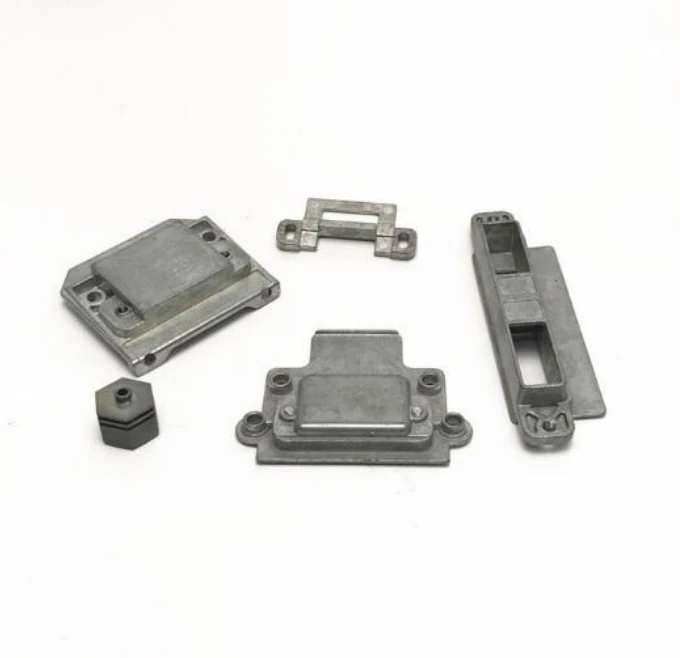
Aluminum alloy die casting process
Cold and hot chamber die-casting are the two basic methods of the die-casting process. In cold chamber die-casting, the molten metal is poured into the die chamber by manual or automatic pouring devices, and then the injection punch moves forward to push the molten metal into the cavity.
In hot chamber die-casting, the die chamber is perpendicular to the crucible. The molten metal flows into the die chamber through the feeding port on the die chamber. The injection punch moves downward, pushing the molten metal through the elbow pipe into the cavity. After the metal solidifies, the die-casting mold is opened, and the cast part is removed, completing one cycle of aluminum alloy die-casting:
Die casting process
FIRST STEP
The first step is to debug the die casting machine. During the debugging process, it is necessary to check whether the working condition of the die casting machine is normal and whether any components are loose or not. Ensure that the die casting machine will not have any problems during use.
01
SECOND STEP
The second step is to start installing the already designed die casting mold. The installation of the die casting mold should be reliable, sturdy, and attention should be paid to whether the die casting mold is normal.
02
THIRD STEP
The third step is to preheat the die casting mold. After installing the die casting mold, it needs to be preheated to prevent damage to the product due to thermal expansion and contraction.
03
FOURTH STEP
The fourth step is to pour. This step requires injecting the material into the mold to form according to the mold's shape.
04
FIFTH STEP
The fifth step is to hold pressure. Since the material has not yet fully formed at this time, it is necessary to maintain the pressure that the die should have, so as to prevent the casting from deforming. After these five steps, the basic casting process of aluminum alloy die casting is basically completed.
05
"four fires"
Among them, the four basic processes in the aluminum alloy die casting industry are annealing, normalizing, quenching, and tempering. These four processes are called the "four fires" in die casting, and their relationship with quenching and tempering is very close. Both are indispensable.
Annealing
Annealing is to heat the workpiece. When heated to the appropriate temperature, depending on the selected material, it is slowly cooled to achieve a state where the internal structure of the metal is close to equilibrium.
Normalizing
Normalizing is to heat the workpiece to a suitable temperature and then cool it in the air. It is mainly used to improve the cutting performance of the material or for some components that do not require high precision as the end of die casting.
Quenching
Quenching is to heat and hold the workpiece, then quickly cool it in water or other inorganic salt solution cooling media. Through this process, the steel piece will become harder and also become brittle.
Tempering
To reduce the brittleness of the steel piece, the quenched steel piece can be placed at a temperature above 650 degrees Celsius but below the normal temperature for a long time for heat preservation, and then cooled. This is called tempering.