

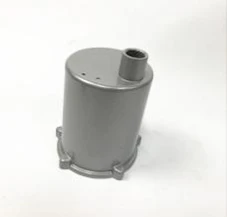
The zinc alloy motor housing is a protective shell for the motor, which is formed by pressing and casting zinc alloy materials. Its product positioning is a key component that takes into account structural strength, electromagnetic shielding, and economicity for mass production. The core structure typically includes a precisely pressed and formed main body, heat dissipation fin design, end cover fixing holes, and grounding terminal interfaces. The surface can be electroplated, sprayed, or treated with multi-color electrophoresis.
|
Original |
Ningbo, China |
| Price | Negotiable |
| Material | Zinc alloy |
| Ton | 800T |
| Payment term | TT |
| Delivery date | Delivery date |
| Packing | Packing |
| Market | USA/Germany/Poland |
| Warranty | Warranty |
| MOQ | 100pcs |
Core structure and process characteristics
Main structure
It is produced by die-casting with Zamak 3/5 zinc alloy, and the wall thickness can be controlled within 1.2 - 2.0 mm.
Integrated heat dissipation fins, mounting bosses, pre-cast structure for cable outlet
Internal reserved stator slot and precise positioning structure for bearing chamber
Process advantages
The Hot Chamber die-casting process enables high-speed production at a rate of 10 to 20 pieces per minute.
The surface can reach a smoothness of Ra 1.6μm or higher, reducing the need for machining.
The tolerance control reaches CT6-7 level (±0.15mm/100mm)
Processing technology
Surface optional chromate coating (resistant to salt spray for more than 240 hours)
Epoxy resin electrostatic spraying (weather-resistant type)
Trivalent chromium black electroplating (providing both protection and aesthetic appeal)
Performance Advantage Details
Electromagnetic Shielding
The volume resistivity of the zinc alloy is only 6.4 μΩ·cm, which can effectively absorb high-frequency electromagnetic waves. It is particularly suitable for scenarios where servo motors and unmanned aerial vehicle control systems are sensitive to electromagnetic interference.
Mechanical properties
Tensile strength: 280 - 330 MPa (superior to ADC12 aluminum alloy)
Impact toughness: 40 - 50 J/cm² (twice that of aluminum alloy)
Hardness: 80 - 85 HB (Better wear resistance than aluminum)
Economic performance
The mold can last for over 1 million cycles (an increase of 30% compared to aluminum)
The material utilization rate exceeds 95% (the pouring and spruing system can be recycled for reuse)
The overall cost is 20-35% lower than that of the aluminum alloy shell.
Application scenarios and compatibility requirements
Miniature precision motor
Robot joint motor
Requires ±0.1mm concentricity. The housing needs to integrate the installation interface for the reducer.
Medical equipment motor: Must pass ISO13485 cleanliness certification and have no impurities on the surface.
Industrial drive motor
Automated equipment stepper motor: The protection level should reach IP65 and be resistant to cutting fluid corrosion.
Pump motor: It is required to withstand a pressure test of 0.3 MPa. The sealing area needs to be specially polished.
Special environmental applications
Automobile windshield wiper motor: Does not deform under temperature cycles ranging from -40℃ to 125℃.
Marine equipment motor: Must pass ISO9227 salt spray test for 500 hours
FAQ
Q: Why zinc alloy instead of aluminum alloy?
A: Zinc alloy has better electromagnetic shielding performance (with a 80-100 dB attenuation), higher casting fluidity, is suitable for more complex thin-walled structures, and the production cost for batch production is 20%-35% lower than that of aluminum alloy.
Q: How is the temperature resistance of the zinc alloy casing?
A: The recommended continuous operating temperature should not exceed 100℃. It can withstand 120℃ for a short period of time, but it will experience creep under high temperatures. A heat dissipation design needs to be used in conjunction with it.
Q: What is the protection level that can be achieved?
A: The standard design can reach IP54 (dust and splash-proof), and with special sealing treatment, it can achieve IP67 (resistant to short-term immersion), which meets the needs of most industrial applications.
Q: Does it support customized design?
A: Yes. The shape of the heat dissipation fins, installation interfaces, cable outlet positions, etc. can all be customized. The surface treatment can also be selected as electroplating, spraying, etc. according to needs.
Q: Is the weight of the zinc alloy motor housing heavier?
A: Its density is 6.6g/cm³, higher than that of aluminum alloy. However, by using a thin-walled design (minimum 1.2mm), the weight can be reduced, and the overall weight is controlled within a reasonable range.
Q: How about the corrosion resistance?
A: The base material has average corrosion resistance. However, through coating treatments (such as nickel plating, electrophoretic coating), it can pass the 500-hour neutral salt spray test and meet the standards of the automotive and other industries.
Q: How long does the production cycle take?
A: The mold production takes approximately 15-20 days. For mass production, it is very fast, with the hot chamber die-casting capable of producing up to 10-20 pieces per minute, making it suitable for large-scale orders.
Q: Are there any environmental protection issues?
A: Compliant with RoHS standards, the waste generated during the production process can be 100% recycled and reused, and the actual material utilization rate exceeds 95%.
Q: Which types of motors does it apply to?
A: It is particularly suitable for micro motors, servo motors, stepper motors, etc. in scenarios with high requirements for electromagnetic shielding and precision. It is widely used in the automotive, industrial, and household appliance sectors.
Q: How to ensure dimensional accuracy?
A: The die-casting process can achieve a precision level of CT6-7 (±0.15mm/100mm). The key parts can be further processed by CNC machining to ensure the mating dimensions.
Q: How is the heat dissipation performance?
A: The thermal conductivity is not as good as that of aluminum alloy. However, by designing heat dissipation fins and air duct structures, it can still meet the heat dissipation requirements of most motors.
Q: How much vibration can it withstand at most?
A: Zinc alloy has excellent damping properties and can withstand vibration tests within the frequency range of 5 to 500 Hz, with an acceleration of up to 5G or more.
Q: What are the options for surface treatment?
A: There are various treatment methods available such as electroplating (nickel, chromium), spraying (epoxy resin), and electrophoresis (black, gray), which can meet different appearance and performance requirements.
Q: What is the minimum wall thickness that can be achieved?
A: The thinnest part can reach 1.2mm. It is recommended to design the thickness to be no less than 1.5mm to ensure structural strength.
Q: Is secondary processing required?
A: The parts can be used directly after die-casting, but the key areas such as the bearing positions and installation surfaces are recommended to undergo precision processing to ensure dimensional accuracy.
Q: What are the main components of the cost?
A: The main costs come from zinc alloy materials (about 60%), mold amortization (about 20%), as well as subsequent processing and handling expenses.
our Partners
We are looking for a cooperative partner to expand our business.
Companies We Have as Clients












Hot Tags: zinc alloy motor housing, China zinc alloy motor housing manufacturers, suppliers, factory