


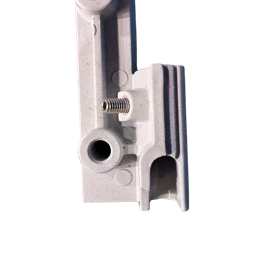
Description of Goods

Product positioning
Aluminum alloy hinges are high-performance connectors specially designed for modern lightweight engineering requirements. They are positioned in the industrial and civil sectors that need to balance structural strength, corrosion resistance, and dynamic opening functions. They replace traditional steel hinges to reduce overall weight and enhance environmental adaptability.
Core structure
Its structure is formed by high-strength aluminum alloy (such as 6061-T6) through die casting or CNC precision processing. It includes a hinge shaft core, a联动page plate with bearing installation holes, a strengthened support frame, and a surface anodized protective layer. Some models integrate ball bearings or damping mechanisms to ensure smooth operation.


Core functions
The core functions are manifested in three aspects: Firstly, through lightweight materials and optimized structures, it can achieve frequent opening and closing actions under high loads; Secondly, by leveraging the natural corrosion resistance of aluminum alloy and surface treatment technology, it can adapt to harsh environments such as humidity and salt fog; Thirdly, through precise processing techniques, it ensures the stability for long-term use and reduces maintenance requirements.
Application scenario
It is widely applied in scenarios such as the folding system of railway vehicle seats, the connection of ship hatches, the opening mechanism of building curtain walls, outdoor foldable equipment (such as camping platforms, mobile power generation equipment), and industrial cabinet panels, especially suitable for dynamic connection parts that are sensitive to weight and need to be exposed to complex environments for a long time.

FAQ
Q: Compared with traditional iron hinges, what are the advantages of aluminum alloy hinges?
A: The main advantages lie in three aspects: Firstly, they are lightweight (weight reduced by 40%-60%), making them suitable for applications where weight is a concern; Secondly, they have excellent corrosion resistance and can resist damp and salt spray environments without the need for electroplating; Thirdly, they offer diverse surface treatments, allowing for customized color through anodizing. However, it should be noted that the ultimate strength of aluminum is still lower than that of high-strength steel, so caution is advised when used in scenarios with extremely heavy loads.
Q: How to select the appropriate load-bearing grade for hinges?
A: The load-bearing capacity mainly depends on the alloy type and structural design: Regular type (6061-T6): Suitable for loads of 20-50 kg (such as cabinet doors, furniture) Enhanced (7075-T6): Capable of carrying 80 - 150 kg (for ship hatches, engineering equipment) It is necessary to pay attention to the torque distribution of the hinges. It is recommended that the actual load does not exceed 70% of the nominal value.
Q: What technical points should be noted during installation?
A: The key installation requirements include: Use special stainless steel or aluminum alloy bolts to prevent electrochemical corrosion caused by contact between different metals. The flatness error of the installation base surface should be less than 0.5mm/m to prevent stress concentration. The core part needs to be pre-lubricated with food-grade grease (such as NLGI 2 grade). Torque control: For M6 bolts, the recommended torque is 8-10 N·m; for M8 bolts, it is 20-25 N·m.
Q: Is special protection necessary when using in marine environments?
A: Although aluminum alloy is inherently resistant to corrosion, it is recommended to take additional measures: Select marine-grade alloys (such as 5083/H116) The surface needs to undergo thick film anodization (>25 μm) Regularly rinse with fresh water to remove salt deposits Avoid direct contact with copper-based alloys
Q: Why do some high-end hinges incorporate bearing structures?
A: Integrating bearings (especially ball bearings) brings about three significant improvements: Convert the sliding friction to rolling friction, and the operating torque is reduced by 60%. Prevent abnormal noises and wear debris caused by direct friction of metals Extend service life, with over 100,000 opening and closing cycles possible
Q: How can one determine if a hinge needs to be replaced?
A: Consider replacing the hinge when the following situations occur: The axial displacement exceeds 1.5mm. There is abnormal sticking during the opening and closing process. Corrosion of the substrate surface (not surface oxidation) occurs. Permanent deformation occurs at the connection point.
Q: Can it be used in extreme temperature conditions?
A: This depends on the specific alloy model. Conventional 6061 alloy: Suitable for -50℃ to 150℃ 7075 high-temperature type: Can be extended to -60℃ to 200℃ When the temperature is below -50℃, be aware of the decrease in toughness; when it is above 150℃, consider the attenuation of strength.
Q: What are the common surface treatment options?
A: Besides the standard anodizing process, the following options can also be chosen: Hard anodizing (HV > 400) enhances wear resistance Electrophoretic coating offers a uniform color solution. The Teflon coating achieves self-lubrication effect. Laser-engraved labels and graduations
Q: How to solve the problem of loose hinges?
A: The looseness may result from three reasons: Installation bolts are loose: They need to be re-tightened according to the torque requirements. Shaft sleeve wear: Replace with oil-filled bearings or ball bearings Material deformation: Reinforce the installation base or add reinforcing plates
Q: Are hinges environmentally friendly and recyclable?
A: Aluminum alloy is a 100% recyclable material, and the energy consumption for its recycling and remelting is only 5% of that of primary aluminum. It is recommended to handle it through formal metal recycling channels to avoid contamination caused by mixing with other metals during the recycling process.
Strategic Partners

Hot Tags: aluminum alloy hinges, China aluminum alloy hinges manufacturers, suppliers, factory